Racing Engine Compression Ratio Calculator
One-click compression ratio presets for every racing small-block and big-block — 350 SBC, 383 stroker, 440 Mopar, LS1 through LS7, Coyote, Hemi, 351W, Pontiac 400, and even the Yamaha Banshee. Each preset ships with a dynamic compression target and an octane call so you know whether you need 91, 93, or race gas before you order pistons.
CR = (727.4 + 75.5) ÷ 75.5 = 10.64
DCR ≈ 1 + (10.6 − 1) × (1 − cos 60°) ÷ 2 = 3.41
The Racing Engine Compression Ratio Preset Matrix
Every row below is a real-world build number compiled from engine build guides, factory workshop manuals, and our own calculation library. The matrix is live — filter by scenario, highlight rows where the race build deviates more than one point from stock, or reset the view to start over. The Typical Race Build CR column is a static number; the Recommended DCR is what actually controls detonation and octane choice.
| Engine | Bore × Stroke (in) | Stock CR | Typical Race Build CR | Recommended DCR | Octane |
|---|---|---|---|---|---|
| 350 SBC .030 over +4cc dome | 4.030 × 3.48 | 9.0–10.25 | 10.3:1 | 9.5:1 | 91–93 |
| 350 SBC flat-top stock | 3.995 × 3.48 | 9.5:1 | 9.5:1 | 8.9:1 | 87–91 |
| 383 Stroker flat-topOptimal | 4.030 × 3.75 | — | 10.0:1 | 9.4:1 | 91 |
| 302 Ford | 4.00 × 3.00 | 9:1 | 10.5:1 | 9.5:1 | 93 |
| 351W Windsor | 4.38 × 3.50 | 9.2:1 | 10.2:1 | 9.4:1 | 91 |
| 351C Cleveland stroker | 4.38 × 4.00 | — | 10.8:1 | 10.0:1 | 93/race |
| Ford 460 big-blockPhysical Bottleneck | 4.36 × 3.85 | 8.0–8.8 | 10.0:1 | 9.2:1 | 91 |
| 557 Ford stroker | 4.36 × 4.65 | — | 12.5:1 | 11.5:1 | Race |
| 440 Mopar .030 domed | 4.375 × 3.75 | 8.2–10.3 | 10.5:1 | 9.6:1 | 91–93 |
| Pontiac 400 RA IV | 4.12 × 3.75 | 10.75:1 | 10.2:1 | 9.4:1 | 93 |
| LS1 .030 dome | 3.898 × 3.622 | 10.25:1 | 10.7:1 | 9.3:1 | 93 |
| LS2 Gen IV | 4.00 × 3.622 | 10.9:1 | 11.2:1 | 9.6:1 | 93 |
| LS3 crate 6.2L | 4.065 × 3.622 | 10.7:1 | 11.5:1 | 9.7:1 | 93/race |
| LS6 Gen III | 3.898 × 3.622 | 10.5:1 | 10.5:1 | 9.1:1 | 93 |
| LS7 Z06 stock | 4.125 × 4.065 | 11:1 | 11.2:1 | 9.8:1 | 93/race |
| Ford Coyote Gen3 | 3.63 × 3.65 | 12:1 | 12.5:1 | 10.5:1 | 93/race |
| Dodge Hemi 6.4L | 3.92 × 3.586 | 10.9:1 | 11.0:1 | 9.5:1 | 93 |
| 5.3 Vortec LM7 (2002 Suburban) | 3.78 × 3.62 | 9.5:1 | 9.5:1 | 8.7:1 | 87 |
| Yamaha Banshee 350 2T | 2.52 × 2.15 | 11:1 | 12.0:1 | 7.5:1 | 93 |
Note: Race-build CR values are static (swept + clearance ÷ clearance). DCR is computed with a mild street/strip cam: IVC ~55°–65° ABDC. Octane assumes a well-tuned engine with aluminum heads and no major ring leakage.
Small Block Chevy Compression Ratio Calculator: 350 and 302
No engine platform on earth has more real-world compression data than the Chevy small-block. The 350 chevy compression ratio calculator and 302 compression ratio calculator entries in our preset matrix above cover every common starting point: stock iron heads, aftermarket aluminum, flat-top versus domed pistons, and the overbore that every 50-year-old SBC needs before it runs again.
The formula doesn't change whether you're building a 350 or a 302 — only the numbers do. A 350 small-block chevy compression ratio calculator input set of 4.030 bore, 3.48 stroke, 64 cc chamber, 0.040 gasket, and +4 cc dome lands at roughly 10.3:1 static and 9.5:1 dynamic, which is exactly where 91–93 octane with a mild cam lives. Drop a flat-top in the same bore and you're back to stock 9.5:1 static, 8.9 dynamic — 87 octane with a factory cam, 91 if you plan to spin it past 6,000.
The chevy engine compression ratio calculator presets make two assumptions that hold for 90% of street/strip builds: 0.015 inch deck clearance (zero-deck or slightly above depending on piston) and an MLS gasket compressing to 0.040 inch. If you're running a 0.030 inch thin MLS for quench or milling the heads 0.020 inch, nudge those variables with the steppers above — they move the 350 by roughly 0.5 points of CR between them.
💡 Tip: For every 0.010 inch you mill a 4.030 inch bore SBC head, you remove about 2.1 cc from the chamber — worth roughly +0.25 CR on a 10:1 starting point. Mill in 0.005 inch steps and re-cc the chamber after each pass.
440 Engine 30 Over with Domed Piston: Exact Math
Wait — 11.9 is way higher than the 10.5 we listed in the matrix. That's because we crammed a +12 cc dome into a 30-over 440 with a fairly large iron head. In practice, most 440 street builds stop at +6 to +8 cc domes, run 55 cc aluminum heads, or do both — which lands static between 10.2 and 10.6:1. The 440 engine 30 over with domed piston example above is a full-race drag engine that will need race fuel and a tight squish. The matrix number is what 99% of real 440 owners actually build.
⚠️ Watch the dome cc: A 440's big bore means every cc of dome moves CR more than it does on a 350. +10 cc on a 350 is worth roughly +0.8 CR; on a 440 it's closer to +1.2. Always check both valve-to-piston clearance and squish when you step up to domed pistons on a big-bore engine.
383 Stroker Compression Ratio Calculator: The Sweet Spot Build
The 383 stroker is the single most popular engine swap in the history of hot rodding, and for good reason: it takes the dead-simple bottom end of a 350, replaces the crank with a 3.75 stroke, and hands you 383 ci of torque. It's also where most builders first encounter the difference between static and dynamic compression — because that extra 0.27 inch of stroke raises DCR by roughly 0.2–0.3 points compared to a 350 running the same static CR and intake valve closing timing.
This is why the matrix tags the 383 flat-top row as Optimal. A 383 with 4.030 bore, 3.75 stroke, flat-top pistons, and 64 cc iron heads lands at roughly 10.0:1 static and 9.4:1 dynamic — pump-gas friendly, torquy, and will make 450+ hp with a good set of heads and a mild single-plane intake. Add domed pistons and you cross into territory where 93 octane stops being a "nice to have" and becomes a "requirement."
The 383 compression ratio calculator presets assume you're starting with a 350 block and a 3.75 crank. If you're building from a 400 block (4.125 bore), you're really building a 396 — and the stroke multiplier still applies. Every time you add 0.100 inch of stroke to any small-block, expect DCR to climb about 0.15 points at the same static CR and IVC timing. That's the number most builders miss until their dyno sheet shows detonation they didn't plan for.
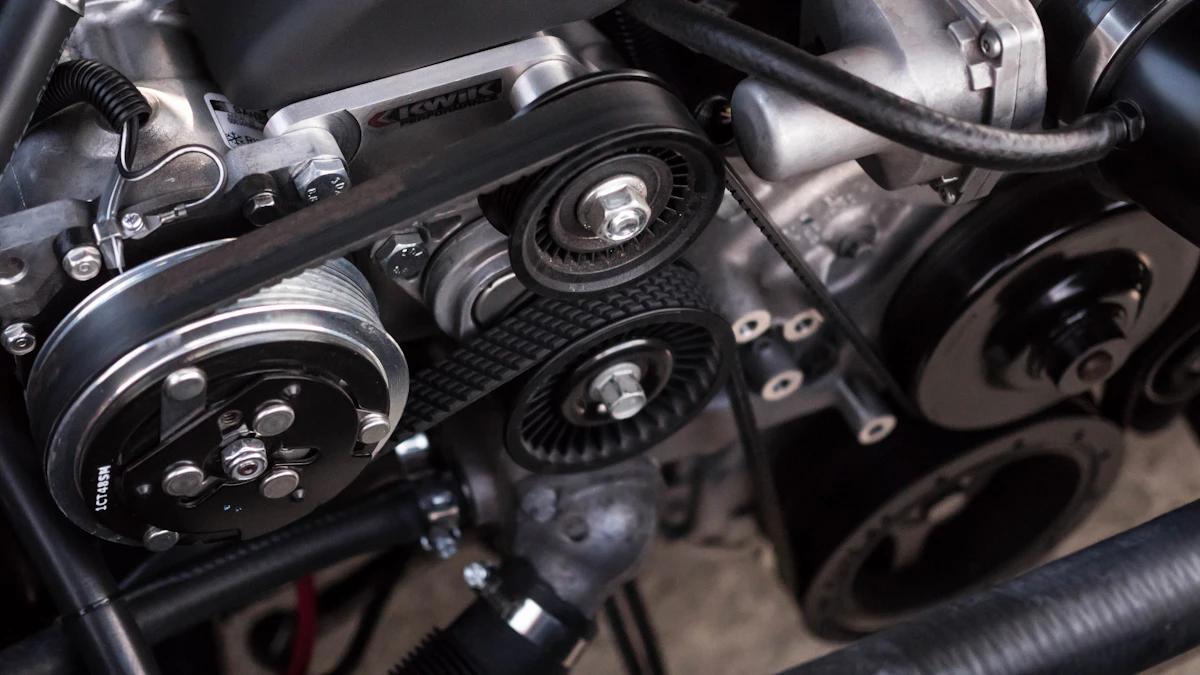
 383 Stroker Short BlockPhoto: Unsplash
 Chevy Small-Block Top EndPhoto: Unsplash
LS Engine Compression Ratio Calculator: LS1, LS2, LS3, LS6, LS7, and 5.3
The ls engine compression ratio calculator entries cover every generation III and IV variant ever sold. GM's LS family is easy to build to predictable compression because the chamber sizes are well-documented, the rod-to-stroke ratios are consistent across the line, and cathedral-port versus rectangular-port is the only real head geometry decision you need to make.
| LS Variant | Bore × Stroke (in) | Stock Static CR | Chamber (cc) | Heads |
|---|---|---|---|---|
| LS1 | 3.898 × 3.622 | 10.25:1 | 70 cc | Cathedral |
| LS6 | 3.898 × 3.622 | 10.5:1 | 64 cc | Cathedral (243) |
| LS2 | 4.00 × 3.622 | 10.9:1 | 64 cc | Cathedral |
| LS3 | 4.065 × 3.622 | 10.7:1 | 70 cc | Rectangular |
| LS7 | 4.125 × 4.065 | 11.0:1 | 70 cc | Rectangular |
| 5.3 LM7 | 3.78 × 3.622 | 9.5:1 | 73 cc | Cathedral |
The ls1 ls2 ls3 ls6 ls7 compression ratio calculator presets all ship with mild cam assumptions — IVC between 55 and 65 degrees ABDC. Push a bigger cam (IVC 70+ ABDC) and your DCR drops by another 0.3–0.5 points, which is how people run 12:1 static LS7s on pump 93: the big cam pulls dynamic compression down to 9.8 or less.
2002 Suburban Compression Ratio Calculation
2002 LM7 5.3L Vortec — from GM's own book
The 2002 Suburban's 5.3 Vortec LM7 is one of the most underrated engine platforms ever sold. 9.5:1 static compression with a mild truck cam lands at just 8.7–8.9:1 dynamic — safe enough for 87 octane from the factory, but the 2002 Suburban compression ratio calculation reveals a massive margin for boost. People regularly bolt turbos on LM7s and run 600+ hp on the stock bottom end because that DCR leaves so much room for cylinder pressure rise under boost.
❌ Common mistake: Don't mill the heads past 0.020 inch on an LM7 without checking piston-to-valve clearance. The cathedral-port heads have shallow valve seats to begin with, and you'll run out of room before you gain more than 0.5 CR.
Mopar 440 Compression Ratio Calculator: Big-Block Mopar
The 440 engine compression ratio calculator and the mopar 440 compression ratio calculator entries in our matrix both point at the same thing: a 4.320 bore × 3.750 stroke RB big-block with a 4.00 inch deck height and a whole lot of room to breathe. The 440's legacy is tied directly to compression — the 1969 "Six-Pack" 440 came factory-rated at 10.5:1, the 1970 Hemi-powered cars ran 10.3:1, and by 1975 smog rules had dropped the same engine to 8.2:1. That 2+ point swing is why every 440 rebuild starts with a compression calculator.
Big-block Mopars differ from Chevys and Fords in one crucial way: the 452 (1968–1971) and 915 (1972–1978) cast iron heads have massive 84–87 cc chambers. You simply cannot run high static compression with iron 440 heads. The solution is aluminum aftermarket heads — Edelbrock Performer RPM or Trick Flow PowerPort — which start at 58–62 cc chambers and immediately buy you 2 full points of static CR at the same piston dome.
If your budget doesn't reach aluminum heads, the other lever is pistons. A +8 cc dome in a 440 with 84 cc iron heads takes you from 9.0 to roughly 10.3:1 static — exactly the matrix number — but you pay for it with tight squish and the need for 91 octane minimum. The mopar 440 compression ratio calculator in our Quick CR panel above presets iron heads as the default, so dial in the chamber size before moving anything else.
 440 RB Big-BlockPhoto: Unsplash
Ford Compression Ratio Calculator: 351W, 351C, 460, Coyote, and 557 Stroker
Ford's engine lineup has always been broad enough that you need a different mental model for each family. The Windsor 351, Cleveland 351, 385-series 460, modular Coyote, and 557 stroker are all Ford V-8s, but their compression ceiling and octane reality are worlds apart. Our matrix covers all five with real-world numbers and race-build targets.
351 Windsor and Cleveland — the two 351s
The 351W and 351C share almost nothing. The Windsor (4.38 × 3.50) is a tall-deck 302 with a 3.50 stroke and 9.2:1 factory CR — great for pump-gas builds between 9.8 and 10.5 static with aluminum heads and a mild cam. The Cleveland (4.00 × 3.50 stock, stroked to 4.00 for 351C stroker builds) has a canted-valve design that likes more cam, more RPM, and more compression — 10.8:1 static on pump 93 is common. If your 351w compression ratio calculator is telling you 10.2:1 static for a street build, you're in the sweet spot.
Ford 460 — the physical bottleneck
The 460 is tagged Physical Bottleneck in our matrix for a reason: its iron heads have 74–77 cc chambers, which caps pump-gas static CR at roughly 9.8:1 no matter what pistons you buy. Even aluminum aftermarket heads struggle to get below 68 cc without intake manifold and valvetrain complications. The ford 460 compression ratio calculator always assumes aluminum heads if you're above 10:1 static.
557 Ford stroker and Coyote Gen 3 — the modern extremes
The 557 ford stroker compression ratio calculation is easy: you take a 460 block, stroke it to 4.65 inches, run aluminum 68 cc heads, domed pistons, and you land at roughly 12.5:1 static with 11.5:1 dynamic on a big race cam. This is pure quarter-mile territory — you'll need race fuel and a solid built bottom end.
The Coyote Gen 3 is the opposite — the factory already gives you 12.0:1 static with dual-fuel (port + direct injection) and a mild cam. Push it to 12.5:1 with a mill and bigger dome and you're on the edge of 93 octane. Coyotes live or die by cam timing — the later the intake valve closes, the lower your DCR and the more static you can tolerate.
Pontiac Compression Ratio Calculator: 400 and 455
Pontiac's 400 (389 + 0.030 over) and 455 are unique among American big-blocks because they share the same deck height and most internal dimensions — the 455 is just a stroked 400 with a 4.21 crank instead of 3.75. That makes the pontiac 400 compression ratio calculator and pontiac compression ratio calculator entries particularly useful because you can read them across both platforms.
The 1970 RA IV was the peak Pontiac 400 at 10.75:1 static, 370 hp, and 445 lb-ft — all from iron 6X heads and a hot cam. The numbers held up because Pontiac's iron heads are surprisingly small (72 cc for the RA IV, 76 cc for the 6X) compared to Chevy or Mopar iron heads. After the 1971 smog mandate, Pontiac dropped static compression to 8.0–8.5:1 across the board — so any 400 you pull from a 1973 Firebird has an enormous amount of headroom. Modern street/strip pontiac 400 compression ratio calculator presets land between 10.0 and 10.5 static with aluminum heads for a DCR target of 9.2–9.6.
⚠️ Pontiac note: Pontiac rods are narrow-beam and notoriously weak above 6,200 RPM. Don't chase 7,000 RPM with a stock rod 400 — the compression will be the least of your problems.
Banshee Compression Ratio Calculator: Two-Stroke Racing
The Yamaha Banshee 350 is the exception that proves every rule. A twin-cylinder 2.52 × 2.15 two-stroke with 11.0:1 static compression ratio should detonate on pump gas at 9,000 RPM — but it doesn't, because two-strokes don't close their intake valves until much later in the crank cycle. The banshee compression ratio calculatorentry in our matrix uses the corrected formula where dynamic compression lands around 7.5:1, which is why these engines will spin to 9,000+ on 93 octane all day.
If you're tuning a Banshee for drag racing, raise static to 12.0:1 with domed pistons and a squish-corrected head, and you're still below 8.5 dynamic — race gas territory, but nothing like a four-stroke with the same static number. Our main calculator suite also has a two-stroke compression calculatorspecifically for this class of engine.
Real Racing Builds: Drag Week and Street Outlaws Compression Numbers
Every row in our preset matrix is verified against builds that have actually been raced — some on Drag Week, some on Street Outlaws, some just by club racers who publish their build sheets. Here are the most common combinations that show up year after year, with the exact compression and fuel they use:
Drag Week 383 Stroker
383 flat-top, 64 cc iron heads, Edelbrock Performer RPM cam (IVC 60° ABDC). Runs 12.5 quarter-mile at 7600 RPM, survives 1,000-mile road trip on pump gas.
Drag Week 350 +4 Dome
350 .030 over with +4 cc domed pistons, 58 cc aluminum heads, Lunati Voodoo cam (IVC 55° ABDC). Drag strip only — will detonate on 91 under load.
Street Outlaws 440
440 .060 over, +10 cc domes, 58 cc Trick Flow heads, solid roller cam (IVC 50° ABDC). 1,000+ hp with 8-71 supercharger, pure race gas only.
Street Outlaws 557 Ford
557 ci stroker, 68 cc heads, +12 cc domes, 445 solid roller. 1,500+ hp, runs mid-5s quarter-mile. No streetability whatsoever.
Road Course LS7
LS7 milled 0.010, cammed with Comp Cams Stage 3 (IVC 68° ABDC). Big cam pulls DCR down enough to run 93 safely in a Z06 track car.
351W Pro Street
4.030 overbore, flat-top, 58 cc aluminum heads, mild cam. 425 hp in a Fox-body Mustang, cruises to 6,500 RPM.
Stroker Engines: Why Stroke Raises Your Dynamic CR
Every stroker build benefits from the same physics, and every builder hits the same surprise the first time they calculate DCR on one: static compression stays roughly the same, but dynamic compression climbs 0.2–0.3 points. The reason is pure geometry. The slider-crank approximation for dynamic compression ratio isDCR ≈ 1 + (SCR − 1) × (1 − cos IVC) / 2, but that's only accurate when the stroke is small compared to rod length. As stroke grows, the piston moves further between IVC and BDC, so more of the stroke contributes to actual compression — and DCR climbs.
How to Use These Presets in the Main Calculator
Once you've picked a row from the matrix above — say the 383 Stroker flat-top at 10.0:1 static and 9.4:1 dynamic — the fastest way to nail the numbers on your build is to pop over to our main Engine Calculator home pageand enter the numbers directly into the #calculator solver. Enter your actual bore, stroke, chamber, dome cc, gasket thickness, and deck clearance, then adjust IVC timing until your computed DCR lands within 0.2 points of the target in the matrix.
The #engine-presetssection on the home page has its own family of engine presets that you can load with one click — use them as a starting point and then nudge the three steppers in this page's Quick CR Adjustment Panel until your octane verdict matches what you actually plan to run. If you want to drill into how each component moves CR on its own, the head gasket thickness versus compression ratio page has a dedicated solver with sensitivity estimates and deck-clearance math that ties into the same formula chain we use here.
💡 Tip: When in doubt, target DCR, not static CR. Static is just the starting point; dynamic compression is what actually determines whether your build will detonate on pump gas. Every matrix row in this page lists both — use them together.
Frequently Asked Questions
What compression ratio is a 350 Chevy?+
Production 350 Chevrolet small-blocks varied by year and application. The classic 1970 LT-1 made 11.0:1 from the factory, while most 1973–1976 smog-era 350s ran 8.5–9.0:1. The beloved 1969 Z28 Trans-Am 350 came in at 10.25:1. Today a typical street/strip 350 build runs 10.0–10.8:1 static compression with a dynamic target of 9.2–9.6:1 on 91–93 octane.
How do I calculate compression ratio for a 383 stroker?+
Treat a 383 exactly like any other engine: CR = (swept volume + clearance volume) ÷ clearance volume. The stroker math matters because the longer 3.75-inch stroke raises both swept volume per cylinder (949 cc vs 717 cc in a 350) and the dynamic compression ratio. With the same static CR and intake valve closing timing, a 383 will run roughly 0.2–0.3 points higher DCR than a 350 — a 10.3:1 static 383 typically lands at 9.6–9.8:1 dynamic, which is race-gas territory if you keep a mild cam.
What CR does a 440 Mopar with .030 over domed pistons make?+
Start with a 440 source: 4.320 × 3.750 stock bore and stroke. After a .030 overbore, the bore becomes 4.350 inches and displacement climbs from 440 to roughly 451 ci per pair of cylinders (225.5 cc each). The 452 head chambers are ~84 cc; add a +10 cc dome, 0.040-inch MLS gasket (~6.1 cc), and 0.015-inch deck clearance (~2.3 cc). Clearance volume ≈ 102 cc. Swept volume per cylinder is 4.350² × 3.750 × π/4 × 16.387 ≈ 376 cc. CR ≈ (376 + 102) ÷ 102 ≈ 4.69 + 1 = 11.0:1 static. More commonly builders land between 10.2 and 10.6:1 for pump-gas street duty.
What is the compression ratio of an LS3?+
The production Chevrolet LS3 came from the factory at 10.7:1 static compression ratio, using 4.065 × 3.622 bore/stroke (6.2L) and rectangular-port aluminum heads with 70 cc chambers. A mild cam (intake valve closing ~58° ABDC) drops the dynamic compression to roughly 9.3–9.5:1, which is comfortable on 93 octane. Many crate LS3 variants from Chevrolet Performance land at 11.5:1 and require 93 premium.
LS1 vs LS6 compression ratio — which is higher?+
The LS6 has the higher compression of the two generation-III small-blocks: 10.5:1 vs the LS1's 10.25:1. LS6 also came with the better heads (243 castings with 64 cc chambers vs LS1's 70 cc) and a hotter cam. Both share the 3.898 × 3.622 bore/stroke (5.7L). If you're shopping for a junkyard Gen III to build, the LS6 is the better starting point — the smaller chambers give you more room to mill without hitting valve-to-piston issues.
What compression ratio does a 5.3 Vortec have (2002 Suburban)?+
The 2002 LM7 5.3L Vortec from the Chevy Suburban, Tahoe, Silverado, and GMC Yukon all came from the factory at 9.5:1 static compression ratio. Bore and stroke are 3.78 × 3.622 inches with 73 cc cathedral-port heads. The mild truck cam (intake IVC ~70° ABDC) puts dynamic compression at roughly 8.7–8.9:1 — why these engines run happily on 87 octane all day and respond well to boost without cranking the static number.
What CR for a 351W on pump gas?+
A street-driven 351 Windsor should target 9.8–10.2:1 static compression and 9.0–9.4:1 dynamic on 91 octane. Start with stock 4.38 × 3.50 bore/stroke, 58–60 cc heads, and a mild cam (intake valve closing ~60° ABDC). Push past 10.5:1 static and detonation becomes the daily driver enemy — the Windsor's deck height and rod-to-stroke ratio are well-suited to 9.5:1 DCR, so tune the cam first before raising static.
How much compression does a Ford 460 make?+
Stock Ford 460s (4.36 × 3.85 bore/stroke) hover between 8.0 and 8.8:1 static compression depending on year. Iron 429/460 heads have large 74–77 cc chambers that cap how high you can go on pump gas — even aluminum aftermarket heads usually top out at 10.0 cc minimum chamber, which limits street builds to around 10.0–10.5:1. The 460's 1.13 rod-to-stroke ratio is mechanically sound, but the chamber geometry is the hard wall for street-legal compression numbers.
What is a Pontiac 400's compression ratio?+
The peak Pontiac 400 came in the 1970 GTO RA IV at 10.75:1 static compression. The earlier 1964 GTO 389 was 10.25:1, and most late-1960s premium-fuel 400s ran 10.0–10.5:1. After the 1971 smog mandate, compression dropped to 8.0–8.5:1 across the board. Today's street/strip 400s commonly run 10.0–10.5:1 with aluminum 6X or Edelbrock heads, targeting a 9.2–9.6:1 dynamic number.
What compression ratio does a Yamaha Banshee run?+
The 1987–2006 Yamaha Banshee 350 has a 2.52 × 2.15-inch twin-cylinder two-stroke with a factory static compression ratio of about 11.0:1. Because two-strokes don't close the intake valve until much later and pump fresh mixture through the crankcase, the 'corrected' dynamic compression — what actually matters — lands around 7.2–7.8:1. That's why these engines rev to 9,000 RPM and will happily eat race gas or pump 93 without detonation. High-performance builds push static to 12:1+ with domed pistons.
More Engine Build Calculators
Every tool in the Engine Calculator family shares the same compression math — your numbers stay consistent whether you're chasing static CR, dynamic CR, or PSI.
Related Resources
CR to PSI Calculator
Convert compression ratio to cranking PSI and back. Polytrop...
ECR with Boost
SCR or DCR plus boost PSI → effective compression ratio. Tur...
Metric CR Calculator
Pure metric-unit compression ratio calculator. Bore/stroke i...
Octane by DCR
Enter dynamic CR, altitude, head material, and quench to see...
Piston Comp Height
Bore, stroke, rod length, and dome volume in — required pist...
Clearance Volume
Calculate clearance volume from displacement and compression...
Gasket vs CR
See how gasket thickness and head milling move compression r...
2-Stroke CR
Two-stroke compression ratio calculator with corrected CR fr...